
What’s In This Guide
- What Are the Key Differences Between Pipe Lining and Pipe Bursting?
- What Is Trenchless Pipe Lining and How Does It Actually Work?
- What Is Trenchless Pipe Bursting and When Does It Apply?
- How Do You Figure Out Which Trenchless Method Is Right for Your Pipe Damage?
- How Damage Location Affects Method and Access
- Commercial Pipe Lining in the Atlanta Area
- Why Does Every Trenchless Repair in Alpharetta Start with a Sewer Camera Inspection?
- Frequently Asked Questions
- Ready to Find Out Which Repair Your Line Actually Needs?
When a sewer line fails beneath your property, the next question is often whether pipe bursting or pipe lining in Atlanta, GA, is the better repair option. Both methods avoid full excavation, but they solve very different types of pipe damage. For Alpharetta homeowners and property managers, the right choice depends on the condition of the existing pipe, access limitations, and what a sewer camera inspection reveals underground.
Quick Facts
- Pipe lining rehabilitates from the inside; pipe bursting replaces it by fracturing outward.
- Camera inspection findings determine the method, not surface symptoms
- Pipe lining suits cracks, corrosion, and root intrusion in structurally intact pipe
- Pipe bursting applies to collapsed or severely deteriorated lines that cannot support a liner
- Trenchless methods protect driveways, slabs, and landscaping that open-cut excavation would damage
What Are the Key Differences Between Pipe Lining and Pipe Bursting?
|
Pipe Lining (CIPP) |
Pipe Bursting |
|
|
How It Works |
Resin liner cured against the interior of the existing pipe |
Bursting head fractures the old pipe outward; new pipe pulled through |
|
Best For |
Cracked, corroded, or root-infiltrated pipe with intact structure |
Collapsed, fully deteriorated, or severely offset pipe |
|
Pipe Condition Required |
Must retain round cross-section and continuous wall |
No structural integrity required in host pipe |
|
Compatible Materials |
Cast iron, clay, PVC |
Cast iron, clay, PVC |
|
Property Disruption |
Minimal; single access point |
Requires entry and exit pits at each end |
|
Common Use Cases |
Joint leaks, hairline cracks, minor root intrusion |
Full collapse, heavy wall fracturing, line upsizing |
What Is Trenchless Pipe Lining and How Does It Actually Work?
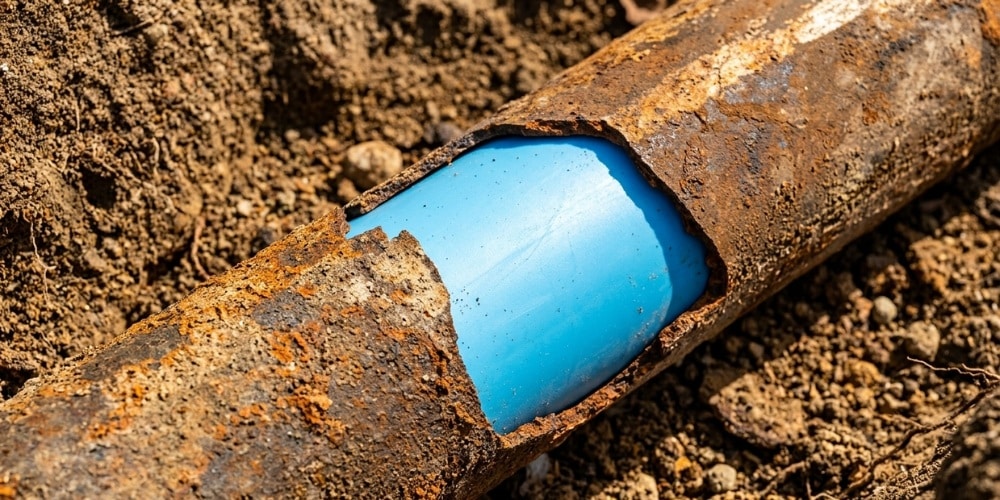
Pipe lining, also called cured-in-place pipe (CIPP) lining, repairs a damaged pipe from the inside without removing it. A resin-saturated liner is inserted, inflated against the interior walls, and cured into a rigid, jointless pipe within the host pipe. The existing pipe stays in the ground.
How the CIPP Process Works
- Sewer camera inspection identifies damage type, location, depth, and pipe condition.
- Hydro jetting clears the pipe interior before liner insertion
- Resin-saturated liner is pulled or inverted into the pipe through an existing access point
- Liner is inflated and pressed against the existing pipe walls
- Resin cures via heat, UV light, or ambient cure depending on liner type
- Post-installation camera inspection confirms liner placement and seal integrity
What Pipe Damage Does Lining Fix?
Lining requires the host pipe to retain a continuous, roughly circular cross-section. It addresses:
- Hairline cracks along the pipe length or at joints
- Minor to moderate corrosion that has not caused wall loss
- Root intrusion through joints without wall fracturing
- Leaking joints and surface scaling on older metal pipe interiors
What Is Trenchless Pipe Bursting and When Does It Apply?
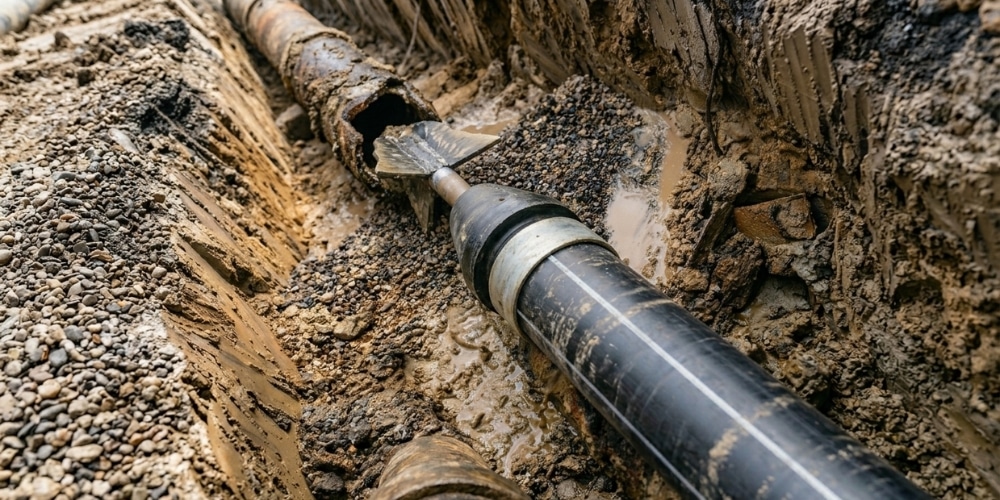
Pipe bursting replaces an existing underground pipe entirely. A hydraulic bursting head fractures the old pipe outward into the surrounding soil while simultaneously pulling a new pipe through behind it. No full-length excavation is required.
How the Pipe Bursting Process Works
- Camera inspection confirms pipe condition, alignment, and access feasibility.
- Entry and exit pits are excavated at each end of the damaged section
- New replacement pipe is staged and connected to the bursting head
- Hydraulic equipment pulls the bursting head through from exit to entry
- Old pipe fractures outward as new pipe fills the vacated space
- Post-installation camera inspection verifies completed replacement
What Conditions Require Bursting Instead of Lining?
- Collapsed pipe sections where the cross-section has deformed or lost its round shape
- Fully deteriorated pipe with extensive wall fracturing across the run
- Severe joint displacement beyond lining tolerances
- Heavy root damage that has fractured the pipe wall rather than infiltrating through joints
- Undersized lines requiring a larger diameter replacement to increase flow capacity
How Do You Figure Out Which Trenchless Method Is Right for Your Pipe Damage?
In Alpharetta, sewer systems vary significantly depending on the age of the property. Older homes may still rely on cast iron or clay sewer lines, while newer developments typically use PVC. Because different pipe materials deteriorate differently, a sewer camera inspection is necessary to determine whether pipe lining or pipe bursting is the more appropriate repair method.
Step 1: What Does the Sewer Camera Inspection Reveal?
Camera footage documents crack patterns, collapse points, root presence, joint offsets, and pipe wall condition across the full run. Properties across Alpharetta, GA, often have mixed-condition pipe runs where one section qualifies for lining and an adjacent section requires bursting.
Step 2: Is the Pipe Still Structurally Intact Enough to Host a Liner?
A CIPP liner needs a host pipe that is round, continuous, and capable of holding the liner against its walls during curing. Buckled, collapsed, or severely separated pipe cannot provide that contact surface.
Step 3: What Material Is the Existing Pipe Made Of?
Cast iron and clay are common in older North Atlanta properties and are generally compatible with CIPP lining when structurally intact. Many Alpharetta homes built before the widespread adoption of modern PVC sewer systems still contain aging cast iron or clay sewer lines.
These materials often remain good candidates for trenchless rehabilitation when structural integrity is still present. Severely deteriorated cast iron with extensive wall loss may require pipe bursting instead.
Step 4: Are There Access Points or Clearance Constraints?
Pipe lining requires a single access point. Pipe bursting requires entry and exit pits at both ends. Properties in Alpharetta, GA, with paved driveways or slab construction may favor lining where access pit excavation would cause disproportionate surface damage.
Step 5: What Does the Inspection Documentation Confirm?
The camera inspection produces video footage, depth measurements, and written condition notes covering the full pipe run. This documentation is the basis for method recommendation and written repair scope. A method recommendation made without this documentation is based on assumption, not confirmed pipe condition.
Decision reference by damage scenario:
|
Damage Scenario |
Recommended Method |
|
Hairline cracks, intact pipe wall |
Pipe Lining |
|
Root intrusion through joints, wall structurally intact |
Pipe Lining |
|
Corrosion with intact tubular shape |
Pipe Lining |
|
Leaking joints, no displacement |
Pipe Lining |
|
Collapsed pipe section |
Pipe Bursting |
|
Severe wall fracturing, deformed cross-section |
Pipe Bursting |
|
Heavy root damage with wall breach |
Pipe Bursting |
|
Undersized line requiring upsizing |
Pipe Bursting |
How Damage Location Affects Method and Access
Pipe condition determines the method. Location determines how access is achieved.
- Under a concrete slab: Lining is strongly preferred. A single cleanout access point preserves the slab surface entirely. This approach is commonly used for sewer pipe lining in Sandy Springs, GA, where minimizing disruption to interior flooring and foundations is often a priority. Bursting requires concrete cutting and post-repair patching at both access pits.
- Beneath a driveway or paved surface: Lining eliminates cut-and-repatch costs along the full pipe path. Bursting needs surface restoration at two pit locations, adding post-job paving work.
- Open yard or landscaped area: Both methods are logistically viable. Method selection follows pipe condition alone, with no surface preservation constraint factoring into the decision. For larger facilities and infrastructure projects, commercial pipe lining in Atlanta is often selected when maintaining access to parking areas, loading zones, and business operations is a key consideration.
Commercial Pipe Lining in the Atlanta Area
Trenchless pipe lining is viable across a wide range of commercial property types requiring pipe lining in Atlanta, GA. Eligibility depends on camera inspection findings, pipe diameter, flow volume, and access configuration.
Commercial properties carry operational constraints that make lining preferable to open-cut work: active operations, expensive paved surfaces over the pipe path, and shared lateral systems serving multiple tenants simultaneously.
|
Property Type |
Why Lining Fits |
|
Restaurants and food service |
Rehabilitates high-use drain lines without kitchen shutdowns or parking lot excavation |
|
Multifamily and HOA |
Addresses shared lateral deterioration without excavating common areas or walkways |
|
Retail centers and offices |
Preserves parking surfaces; eliminates post-repair patching over occupied lots |
|
Municipal and institutional |
Supports 811 utility coordination, trench safety compliance, and minimal service interruption |
Why Does Every Trenchless Repair in Alpharetta Start with a Sewer Camera Inspection?
A sewer camera inspection is the only way to confirm which repair method applies to a specific pipe condition. Surface symptoms indicate a problem exists. Camera footage identifies what the problem is, where it is, and whether the pipe supports a trenchless approach at all.
Symptoms Do Not Tell the Full Story
A slow drain or wet yard patch points to a problem underground. It does not identify whether the pipe is cracked, collapsed, root-infiltrated, or offset. Without visual confirmation of pipe wall condition, any method recommendation is an assumption, not a diagnosis.
Wrong Method Selection Has Real Consequences
Applying pipe lining to a collapsed pipe means the liner has no intact wall to adhere to. The repair fails. Recommending pipe bursting on a pipe that only needed lining means unnecessary excavation and cost. The inspection eliminates both risks before any work begins.
The Footage Becomes the Repair Record
Camera inspection produces video footage, depth measurements, written condition notes, and pipe material identification across the full run. That documentation scopes the repair, confirms method eligibility, and serves as the written record for the completed installation.
What every inspection documents:
- Exact damage location and depth from the nearest access point
- Pipe wall condition: cracked, corroded, collapsed, or displaced
- Root presence: joint infiltration versus structural wall fracture
- Obstructions, offset joints, and belly sections along the run
- Pipe material type and estimated installation era
➤ READ NEXT: What Is a Sewer Camera Inspection and When You Need One
Frequently Asked Questions
Can pipe lining and pipe bursting be used together on the same job?
Yes. When different sections of the same pipe run present different damage conditions, both methods can be sequenced within a single project. Camera inspection maps each section so the correct method is applied where it fits.
How long does trenchless pipe lining typically last?
CIPP pipe lining has an estimated service life of 50 years or more when correctly installed. Actual lifespan depends on pipe conditions, operating environment, and installation quality.
What are the most common signs of a damaged sewer line?
Recurring drain backups, slow drains across multiple fixtures, sewage odors, wet patches in the yard, and unexplained spikes in water bills are the most common indicators. These symptoms do not confirm damage type or location. A sewer camera inspection is required to identify what is happening inside the pipe.
Is trenchless pipe repair covered by homeowner’s insurance?
Insurance coverage varies by carrier, policy terms, and the cause of damage. Homeowners should review their policy or speak directly with their insurance provider to determine whether sewer repairs may qualify for coverage.
Can tree roots grow back after a trenchless repair?
CIPP lining creates a seamless, jointless interior surface with no gaps for roots to re-enter. Pipe bursting replaces the host pipe entirely, eliminating existing entry points. Periodic camera inspections after either repair confirm the line stays clear over time.
Ready to Find Out Which Repair Your Line Actually Needs?
Zippy Plumber begins every job with a sewer camera inspection before any method is recommended or any ground is opened. Findings are documented on video with written notes and measurements, so you know exactly what the pipe condition is and which repair approach fits it.