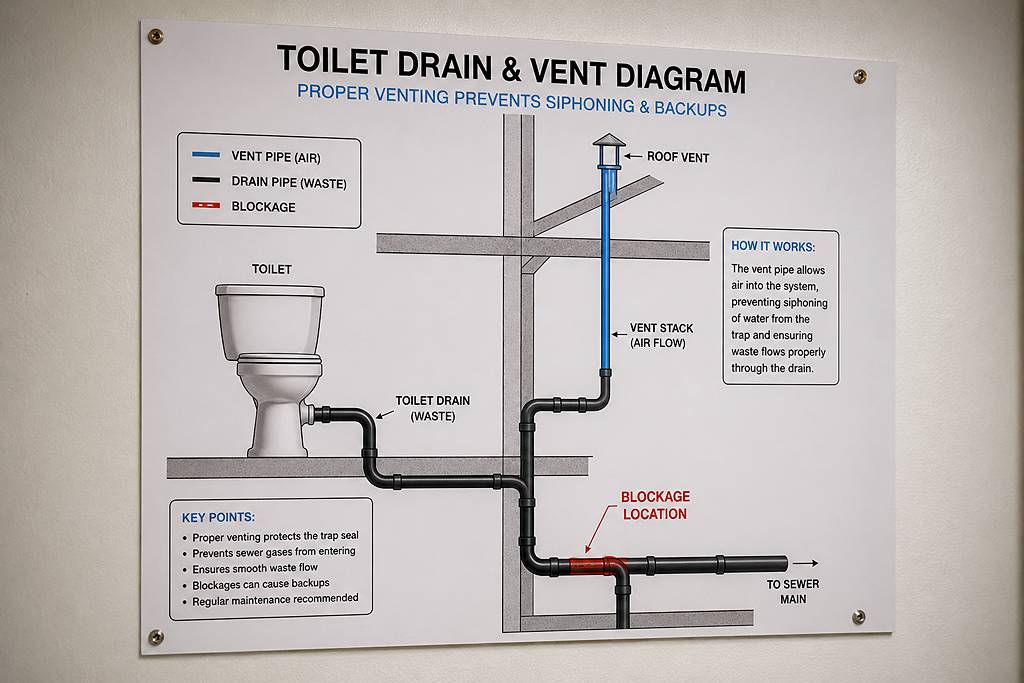
Toilet gurgling when flushed is almost always a sign that air is being forced back through the drain system due to a blockage or venting failure. Additionally, catching this early can prevent a much more serious and expensive plumbing problem down the road.
Table of Contents
- What the Gurgling Sound Actually Means
- The Most Common Causes of Toilet Gurgling When Flushed
- How to Diagnose the Problem Yourself
- DIY Fixes Worth Trying First
- When the Problem Is Underground
- What a Professional Inspection Covers
What the Gurgling Sound Actually Means
When water drains from your toilet, it needs to displace air inside the pipe. Under normal conditions, that air moves out through the vent stack. This is a vertical pipe that runs from your drain system up through the roof.
However, when that pathway becomes restricted, or when a blockage slows water flow through the sewer line, trapped air escapes backward. As a result, air pushes up through the water in your toilet bowl and produces that distinctive gurgling noise.
The sound itself is not just a nuisance. Furthermore, it is a pressure signal. It tells you something in your drain or vent system is fighting against the normal flow of water and air. Ignoring it long enough often leads to slow drains, sewage odors, or in the worst cases, a sewage backup.
According to Horow (2025), 80 to 90 percent of gurgling toilet cases stem directly from a blocked drain line or a clogged vent stack. A Master Plumber cited by Call Mother (2025) puts the figure even higher. This expert states that 95 percent of gurgling or bubbling toilets trace back to a blocked sewer line specifically. Both perspectives reinforce the same point: this is almost never a mechanical problem with the toilet itself.
The Most Common Causes of Toilet Gurgling When Flushed
Understanding what most likely causes the gurgle helps you decide how urgently to act. Moreover, it helps you determine who to call. These are the four main culprits, listed roughly in order of frequency.
1. Clogged Toilet or Drain Line
A partial clog inside the toilet trap or the drain line immediately downstream represents the most accessible cause. Toilet paper buildup, non-flushable wipes, or foreign objects create a restriction. As a result, air escapes backward through the bowl when you flush. This type of clog usually produces gurgling that happens consistently every single flush.
2. Blocked Vent Stack
The plumbing vent stack keeps air pressure balanced across your drain system. When it gets blocked, typically by leaves, bird nests, or debris collecting at the rooftop opening, negative pressure builds up every time water drains. That vacuum pulls air backward through the nearest water trap, which is often your toilet bowl. Additionally, a blocked vent stack frequently causes gurgling in multiple fixtures at once, not just the toilet.
3. Main Sewer Line Obstruction
This is the most serious cause and the one that tends to escalate fastest. Your home’s main sewer line carries all wastewater from every fixture out to the municipal sewer or your septic system. A buildup of grease, roots from nearby trees, or accumulated debris can partially or fully block this line. You may notice that flushing the toilet causes the bathtub drain to bubble. In addition, running the washing machine makes the toilet gurgle. These cross-fixture symptoms are a strong sign the obstruction is in the main line, not a branch drain.
Homeowners who routinely pour fats down the kitchen sink significantly increase their risk of main line buildup. Understanding how to dispose of bacon grease properly is a simple preventive step that reduces the grease load on your sewer system over time.
4. Municipal Sewer Blockage
In some cases, the problem is not in your pipes at all. The city sewer main that your lateral connects to can become congested, especially in older neighborhoods with aging infrastructure. Gurgling caused by a municipal blockage typically affects multiple homes at the same time. Therefore, if your neighbors mention similar symptoms, contact your local utility or public works department before spending money on repairs to your own line.
How to Diagnose the Problem Yourself
Before calling a plumber, a few quick observations can narrow down where the blockage is. Moreover, they reveal how serious the situation might be.
Check multiple fixtures. Flush the toilet and watch the bathtub and bathroom sink drains. If bubbles appear in those drains too, or if water backs up into the tub, the obstruction is likely in the main sewer line rather than a fixture-specific clog. Additionally, check whether you are noticing any what causes low water pressure issues throughout the house, since both low pressure and gurgling together can point to more widespread plumbing problems.
Look for slow drains. A toilet that gurgles and also drains slowly after flushing suggests a partial blockage in the drain line near that fixture. However, a toilet that gurgles but drains at normal speed more likely has a venting issue.
Time the gurgling. If the gurgling only happens when another fixture runs, such as a dishwasher or washing machine, it points strongly to a shared drain obstruction rather than a toilet-specific problem.
Listen at the cleanout. If your home has a cleanout access point on the exterior, remove the cap carefully. A strong sewage odor or visible standing wastewater inside the cleanout indicates the main line is blocked and cannot drain properly.
DIY Fixes Worth Trying First
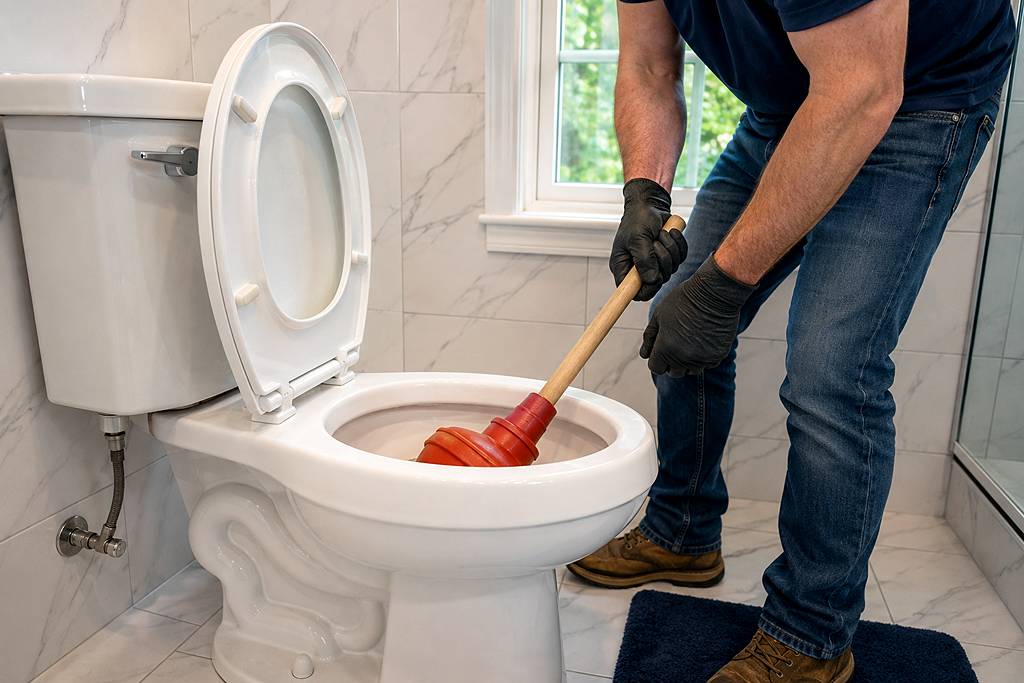
For simple clogs confined to the toilet itself, a few tried-and-tested methods are reasonable starting points before calling a professional.
Use a flange plunger. A standard cup plunger is designed for flat drains. However, for toilets, you need a flange plunger, which has a rubber extension that fits into the drain opening and creates a proper seal. Plunge firmly and repeatedly to dislodge soft clogs.
Try a toilet auger (closet snake). Also called a closet auger, this tool extends through the toilet trap and can break up or retrieve obstructions that a plunger cannot reach. It is widely available at hardware stores for under $30.
Clear the vent stack if you can do so safely. If you are comfortable working on your roof and have the right equipment, you can check the vent stack opening. Furthermore, you can use a garden hose to flush out any leaf or debris buildup. Do not attempt this without fall protection.
If the clog is somewhere else in your drain network, such as a shared bathroom drain, a targeted approach often helps. Our detailed bathroom sink clog fix walkthrough covers the most effective DIY techniques for branch-line clogs in bathroom plumbing.
Similarly, if your kitchen drain is also running slow alongside the gurgling toilet, addressing that separately may relieve some pressure on the system while you wait for a professional inspection. Our resource on how to unclog kitchen drain outlines safe and effective methods that do not rely on harsh chemical drain cleaners, which can damage older pipe materials.
What to avoid: Chemical drain cleaners like sulfuric acid or caustic soda formulas can clear some soft clogs but are not effective against root intrusion or serious structural blockages. Therefore, overuse of these products can corrode older cast iron or PVC pipes and compound the original problem.
When the Problem Is Underground
If your DIY efforts do not stop the gurgling, or if you are seeing symptoms across multiple fixtures simultaneously, the blockage is very likely in the exterior sewer lateral. This is the underground pipe that runs from your home’s foundation to the city sewer connection at the street.
This stretch of pipe is your responsibility as a homeowner under most municipal codes. You must maintain and repair it from the building to the property line. In many jurisdictions, you are responsible all the way to the sewer main connection. Root intrusion from trees and shrubs is the single most common cause of exterior lateral failure. Tree roots seek out water and naturally migrate toward the small fractures that develop in aging clay, cast iron, or even PVC pipes over time. Once inside, roots form a lattice that catches toilet paper and debris. As a result, they progressively narrow the pipe until water flow is severely restricted.
Other exterior causes include pipe bellying (where a section of pipe sags due to soil movement, creating a low spot where solids accumulate), corrosion in older metallic pipes, and joint separation caused by ground shifting.
Diagnosing an underground obstruction requires a camera inspection. A plumber inserts a waterproof video camera through the cleanout to visually inspect the interior condition of the pipe. This reveals root intrusion, pipe damage, and the precise location of any blockage. It is the only reliable way to confirm that the problem is in the lateral rather than elsewhere in the system.
What a Professional Inspection Covers
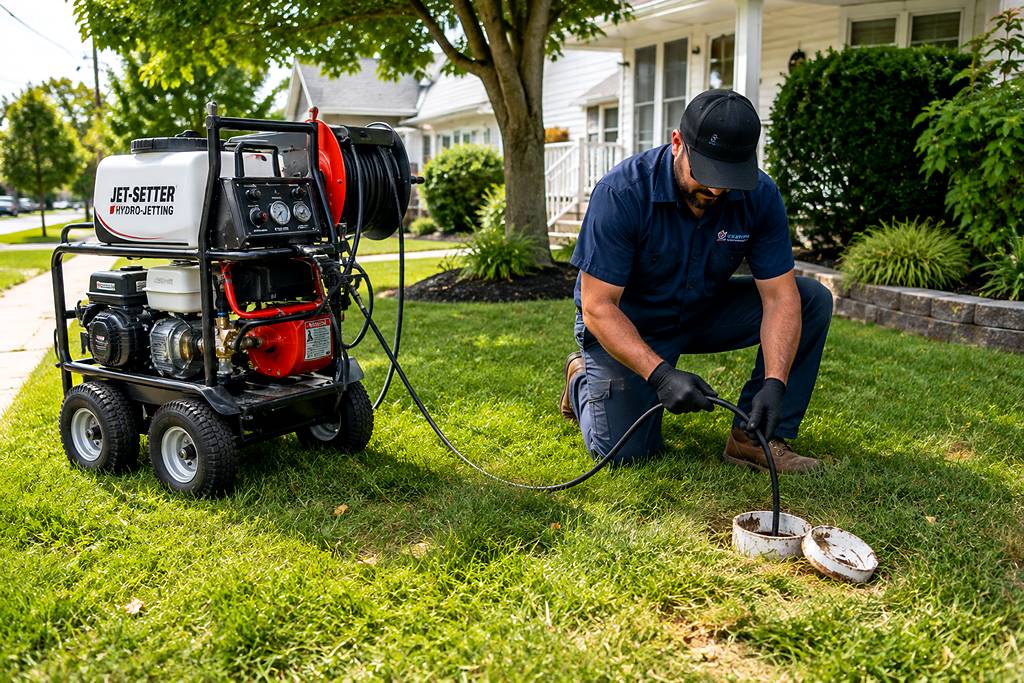
Resolving toilet gurgling when flushed due to an exterior or main line cause is not a DIY job. The equipment required includes hydro-jetting machines, pipe cameras, and locating devices. This equipment is specialized and expensive.
At Zippy Plumber, we focus exclusively on exterior underground plumbing. Specifically, we handle the sewer lateral that runs from your building out to the street. We do not handle indoor fixture repairs, but when the source of a gurgling toilet traces back to the underground pipe, that is exactly our scope of work. A camera inspection will confirm whether you need hydro-jetting to clear the line, pipe lining to rehabilitate a deteriorating lateral, or a full pipe replacement.
Hydro-jetting uses water at pressures typically between 3,000 and 4,000 PSI to cut through root intrusion, grease buildup, and sediment in a way that standard snaking cannot. It clears the full diameter of the pipe rather than just boring a hole through the clog. For lines with structural damage, trenchless pipe lining is often a more cost-effective solution than full excavation. This approach allows a new pipe liner to be installed from access points without tearing up landscaping or driveways.
If you are in the Alpharetta, GA area and your toilet has been gurgling despite clearing the visible fixtures, it may be time to have the underground lateral evaluated before a partial blockage becomes a full sewage backup.
| Cause | Location | DIY Possible? | Professional Method |
|---|---|---|---|
| Toilet trap clog | Toilet fixture | Yes, plunger/auger | Manual snaking |
| Vent stack blockage | Roof/interior vertical pipe | Possibly, with caution | Vent clearing, camera check |
| Branch drain obstruction | Interior drain line | Partially, with snaking | Snaking, hydro-jet |
| Main sewer line clog | Underground, under slab | No | Camera + hydro-jetting |
| Exterior sewer lateral | Underground to street | No | Camera, jetting, lining |
| Municipal sewer issue | City property | No | Contact public works |
Things to Know
- Gurgling from a single toilet that resolves after plunging is usually a localized clog. However, gurgling that returns within a few days, or that affects multiple fixtures at once, almost always points to a deeper obstruction in the main sewer line or exterior lateral.
- Your sewer lateral is your financial responsibility. Most municipalities in the United States place the cost of repairing the underground pipe from the home to the city connection entirely on the homeowner, even if the break is near the street. Therefore, check your local utility code before assuming the city will cover any repair.
- Chemical drain cleaners do not fix root intrusion or pipe bellies. They are formulated to dissolve organic soft clogs, not to cut through roots or correct structural issues. Moreover, using them repeatedly on a line that has root intrusion can accelerate pipe corrosion without addressing the actual cause.
- A blocked vent stack can mimic a drain clog. If a plumber clears your toilet drain and the gurgling comes back within days, ask specifically about a vent stack inspection before agreeing to additional drain work.
- Older homes built before the 1980s are more likely to have clay or cast iron sewer laterals. Both materials are significantly more susceptible to root intrusion and joint separation than modern PVC pipe. If your home is in this age range and you have never had the lateral inspected, a camera check is a reasonable precaution even before symptoms appear.
- Never ignore gurgling paired with sewage odor indoors. That combination suggests wastewater is being held back somewhere in the system. As a result, it may be creating conditions for a backup. At that stage, professional evaluation is not optional.
Schedule Your Underground Pipe Inspection Before a Gurgling Toilet Becomes a Sewage Backup
A gurgling toilet is your drain system signaling that something is wrong. Therefore, waiting too long to act typically turns a manageable obstruction into a full sewage backup that costs far more to remediate. If you have already tried clearing the fixture and the problem has not resolved, the next step is a professional camera inspection of your exterior sewer lateral. Request a free estimate from Zippy Plumber today and find out exactly what is happening inside your underground pipe before the situation escalates. Call or submit your request online now, and our team will assess your exterior lateral and give you a clear, honest picture of what the repair requires.
Frequently Asked Questions
Q: Is a gurgling toilet an emergency?
A gurgling toilet is not always an immediate emergency. However, it should never be left unaddressed for more than a few days.
If the gurgling is isolated to one flush and clears up on its own, you likely have a minor partial clog that may respond to plunging. However, if the gurgling is persistent, accompanies slow drains across multiple fixtures, or comes with sewage odors inside the home, treat it as urgent. A developing sewer line blockage can progress to a full backup relatively quickly, especially in households with high daily water use.
Q: Can a gurgling toilet fix itself?
No, a gurgling toilet will not fix itself in any meaningful sense.
The underlying cause, whether a partial clog, a blocked vent stack, or root intrusion in the sewer lateral, does not resolve without intervention. What sometimes happens is that a soft clog breaks apart and the gurgling temporarily stops. As a result, it only returns when debris accumulates again at the same restriction point. This cycle of intermittent gurgling is actually a warning sign that the obstruction is still present and growing.
Q: Why does my toilet gurgle when I flush another fixture, like the bathtub or washing machine?
When flushing or running one fixture causes your toilet to gurgle, the blockage is almost certainly in a shared drain line. Therefore, it is not the toilet itself.
All the drains in your home eventually connect to a single main sewer line before exiting the building. When that shared line is partially blocked, water draining from any upstream fixture pushes air through the path of least resistance. This is often your toilet’s water trap. This cross-fixture gurgling is one of the clearest diagnostic signs that the problem is in the main sewer line or exterior lateral rather than a branch drain. Therefore, it warrants a professional camera inspection rather than a DIY fix.
Q: How much does it cost to fix a gurgling toilet caused by a sewer line blockage?
The cost varies significantly depending on whether the blockage requires simple hydro-jetting, pipe lining, or a full sewer lateral replacement.
A professional drain cleaning or hydro-jetting service for a main line obstruction typically runs several hundred dollars. Additionally, trenchless pipe lining for a damaged lateral can run into the low thousands depending on pipe length and access conditions. Full sewer lateral excavation and replacement is the most expensive option. This often ranges from a few thousand dollars to significantly more for long runs or difficult access. Getting a camera inspection first is the most cost-effective way to understand exactly what you are dealing with before committing to any repair method.
Q: How do I know if my sewer vent stack is blocked rather than my drain line?
The clearest sign of a blocked vent stack, rather than a drain clog, is gurgling that occurs across multiple fixtures without any corresponding slow drainage.
With a drain clog, water movement is visibly restricted. However, with a venting problem, water may drain at a relatively normal speed but air cannot escape properly. As a result, it reverses back through water traps and produces gurgling or bubbling sounds. You may also notice that the gurgling happens most often during periods of high fixture use, such as when multiple people are showering or running water simultaneously. A licensed plumber can confirm a vent stack blockage by running a camera from the rooftop vent opening or by performing a pressure test on the vent system.